Refrigerated Medication in a Hotel Without a Fridge: How to Get Organized

Refrigerated medication in a hotel without a fridge: how do you get organized? Ask the hotel before booking: is there a room fridge, and what happens to the power when you leave? If the answer isn't clear, choose a solution in advance: the reception fridge, a cooler bag with ice packs, or a portable medication fridge that plugs into the room outlet and stays within 2 to 8°C (36 to 46°F) as long as it is plugged in (to an outlet, or to a power bank, sold separately).
In this article
What should you ask the hotel before you book?
Six questions, in writing, before you pay. A written answer is worth more than "yes, there's a fridge" over the phone, because you can show it at reception when you arrive.
- Is there a fridge in the room we booked? It's worth asking whether every room has one or only some, and asking for an answer about your room type.
- Is it a regular fridge or a minibar? It's worth asking whether it cools like a home fridge, and whether you can clear space in it for a personal item.
- Does the power in the room stay on when the key card is removed? It's worth asking whether the fridge and the outlets keep working when the room is empty, and whether one outlet is always on.
- Can we leave an item in the reception or staff fridge? And if so, at what hours can you get it back, including at night.
- Can you freeze an ice pack for us? And how far ahead do you need to hand it over.
- Can we get a fridge in the room on request? And whether there's a charge for it.
In a guesthouse or a holiday apartment, send the same questions to the owner. There's no need to say which medication: it's enough to write that you have an item that needs continuous cooling.
What do you check at check-in and in the room itself?
Three things, before you unpack. They take a few minutes, and they save you a late discovery at night.
- The fridge. Open it and see whether it's running, and whether there's free space in it.
- The outlet. Find an outlet near the desk or the bed, plug a phone charger into it, remove the key card and see whether charging continues.
- Reception. Make sure the current shift knows what was agreed in writing, and ask who to turn to at night.
Didn't find what was agreed? Ask for a different room or a fridge in the room now, before you settle in, not the next day.
Minibar or fridge: how do you know what's in the room?
A "room fridge" in a booking can also be a minibar, the small fridge where the hotel offers drinks and snacks. Before you decide to put medication in it, it's worth finding out what you're dealing with.
- Ask what exactly is in the room. That's question 2 above: a regular fridge or a minibar, and whether you can clear space in it for a personal item.
- Ask whether it runs when the room is empty. If the room's power depends on the key card, the minibar may depend on it too. That's question 3.
- Check it yourself at check-in. Open it and see whether it's running. If you have a thermometer, you can leave it inside and check what it shows after a few hours.
Every minibar is different, so the way to know is to check. The range your medication needs is written in its patient leaflet.
What are the options in a room without a fridge you can rely on?
There are four types of solution, and each has its own limitation. The table sorts them by what they require from you and from the hotel.
| Type of solution | What it needs | How you see the temperature | The limitation |
|---|---|---|---|
| Hotel room fridge | A room with a working fridge | Only if the fridge has a display | Depends on the room and its power, and you only know for sure when you arrive |
| Reception fridge | The hotel's agreement | You don't, the item isn't with you | Depends on the staff and the hours, and the item isn't within reach |
| Cooler bag with ice packs | An available freezer, to refreeze the ice packs | Only if you add a thermometer | The ice packs melt, and without a freezer there's no way to continue |
| Portable medication fridge (active cooling) | A live power outlet in the room | On the fridge's display, as long as it is plugged in | Depends on power, and there is no alert when it is disconnected from power |
Full disclosure: we sell the fourth type. Keep that in mind when you read the table, and choose according to your hotel and your trip.
How does a portable medication fridge work in a hotel room?
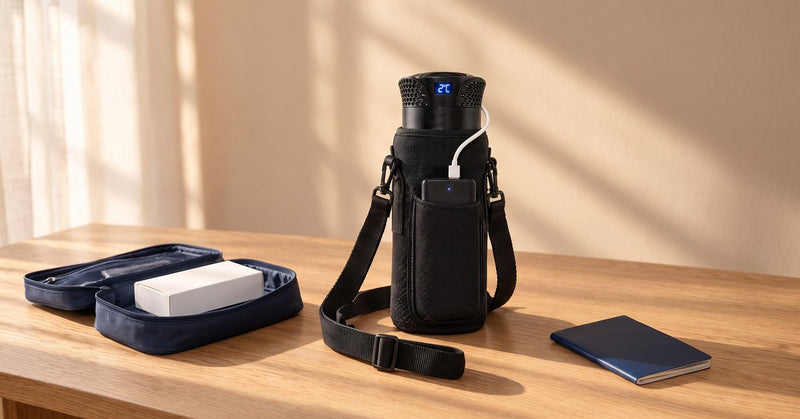
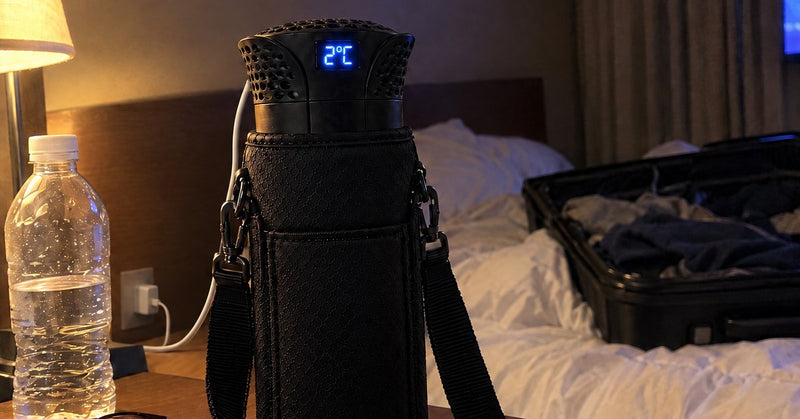
You plug it into the room's outlet with the charger that comes in the box, and it produces cold by itself. For trips abroad, add a plug adapter for the sockets of your destination country. The Secrets Box, a portable medication fridge by Practi, stays within 2 to 8°C (36 to 46°F) as long as it is plugged in to a wall outlet or a power bank. The power bank is sold separately. When it is plugged in, the temperature is shown on a digital display, so you don't have to guess. A smart system prevents freezing.
The box includes a USB to USB-C cable, a wall charger and a bio-gel ice pack. First you plug it in and wait until the display shows 2 to 8°C (36 to 46°F): within 15 to 20 minutes for the XL 2.0, within 20 to 30 minutes for the base model. Only then do you put the medication in.
The limitation worth knowing: there is no alert when it is disconnected from power. If the power in the room shuts off when the key card is removed, the fridge stops cooling and nothing tells you. That's why question 3 and the outlet check at check-in matter here too: they are what shows whether the outlet keeps working when the room is empty. A dark display means the fridge is not getting power, so glance at it from time to time.
For a room without continuous power there are two ways. The first: a 10W power bank (20,000mAh or more recommended, 10,000mAh also works), and the power bank is sold separately. The second: the bio-gel ice pack, as a backup for when there's no power. According to supplier data, with the ice pack the fridge stays within the cooling range for about 30 hours at an ambient 35°C (95°F). The ice pack is frozen at least 12 hours ahead, hence question 5. The medication doesn't touch the ice pack directly.
The display works only when the fridge is plugged in, so in ice pack mode there is no temperature reading.
The rule: either power or the ice pack, never both together. When the fridge is plugged in, you don't put an ice pack in it.
Want to know if your pen fits? Look it up in the pens list. And what to check before you buy a fridge like this, item by item: Portable medication fridge: what to check before you buy.
Where is it written what your medication needs?
In the medication's patient leaflet, and with your pharmacist. Not here. We don't write what temperature a specific medication should be kept at, or what it means if it went outside the range. Those are questions for the leaflet, the pharmacist and your doctor.
Clalit Health Services, an Israeli health fund, writes on its page about medication for travel (in Hebrew) that it's worth consulting a pharmacist before you leave. That's a chance to ask about the days at the hotel as well.
Source: Clalit Health Services, medication to take abroad (Hebrew)
We laid out the way to the leaflet itself in our guide on how to find the official storage instructions for a medication that needs refrigeration. A logistics tip: photograph the storage section on your phone before you leave, so it's with you in the room too.
Questions that keep coming up
Is there a hotel fridge for medication in every room?
It depends on the hotel and the room type. That's why you ask in writing before booking, and ask for an answer about the room you booked and not about the hotel in general.
Can I keep medication in the hotel minibar?
It depends on the minibar and on what your medication needs. Minibars differ, so ask the hotel whether it's a regular fridge and whether it runs when the room is empty, and check the range in your medication's patient leaflet. If the answers aren't clear, there are alternatives: the reception fridge, a cooler bag with ice packs, or a portable medication fridge that stays within 2 to 8°C (36 to 46°F) as long as it is plugged in (the power bank is sold separately).
Can you keep refrigerated medication in a hotel without a fridge in the room?
Yes, there are several ways to get organized: the reception fridge if the hotel agrees, a cooler bag with ice packs that you refreeze, or a portable medication fridge that plugs into an outlet. Each way has a limitation, and they are listed in the table above.
Is the portable fridge noisy at night?
It's quiet, under 40dB, so you can leave it on the desk or next to the bed. After several days in a row the fan works harder, and half an hour of rest brings it back to quiet.
Staying at the hotel for more than 4 days, is there anything worth knowing?
Yes. In continuous use of more than 4 days, it's recommended to unplug the fridge for a break of 20 to 30 minutes now and then.
Sounds expensive for a few nights in a hotel? Against replacement medication, a day of the trip spent looking for a fridge, and peace of mind, the math looks different. All the details are on the page of the Practi portable medication fridge. And if you're still packing, the packing checklist for patients traveling abroad sorts out what's left.
How this article was written. We gathered this information from public sources online and brought it together in one place. We are not a medical body, we have no medical or pharmacy qualification, and no medical professional has gone over this article.
Accurate as of the update date shown at the top of this article. Information may change. Security procedures, airline guidelines, medication leaflets and product specifications change from time to time, and the information here may no longer be up to date. It is the reader's responsibility to verify every detail with the official source before acting on it.
This article is general information, not medical advice. For questions about your medication, talk to your pharmacist or doctor. It contains no recommendation on medication storage, dose, method of use or how long a medication stays usable. The only sources for those questions are your medication's patient leaflet, your pharmacist and your doctor. Responsibility for storing and using the medication lies solely with the user and their healthcare provider. The Secrets Box is a cooled carrying case for medication and is not a medical device.
Another question? All frequently asked questions · or message us on WhatsApp