How to Find the Official Storage Instructions for a Medication That Needs Refrigeration

The storage instructions for a medication that needs refrigeration are written in its patient leaflet, in a section called "How to store the medication?". There are three places to get it: the printed leaflet inside the box, the Israeli Ministry of Health drug database, and the pharmacy. This guide shows how to get to each of them, and how to read what's written there correctly.
In this article
This information is general and for convenience only, and it is not medical advice. Medication storage, temperatures and doses are set by your doctor, your pharmacist and the manufacturer's leaflet. Talk to a professional before making any decision.
Why there's no number here
It would have been easy to put together a table of medications and how long each one lasts outside the fridge. We chose not to, and not only out of legal caution.
We sell a cooled carrying case for medication. The moment a number like that appears on a website that sells a fridge, it stops reading as a quote and starts reading as our instruction. We are not a medical body, and we have no qualification to give that kind of instruction.
There's also a practical reason, and it may be the more important one. The leaflet gets updated, and it differs between products and sometimes even between doses of the same active ingredient. In Israel, the same active ingredient can have several brand names, from several registration holders, and each one publishes its own leaflet. A number that's right for one of them isn't necessarily right for the box in your fridge.
So this article does something else. It shows you where your number is written, so you can read it from the source.
The short route: the box you already have
Before you open a computer, it's worth opening the drawer. Inside every original medication box there's a printed patient leaflet, and it's the version authorized for the specific product you received, with its registration number and its dose. That's the document that counts for you, more than any file someone sent on WhatsApp and more than any web page.
Two things that take a minute: photograph the storage section on your phone, zoomed in so it's readable, and also photograph the side of the box printed with the brand name, the dose and the expiry date. On a trip, when the leaflet is crumpled in your bag, the photo on your phone is what you'll actually look at.
If you threw the leaflet away, or got pens without the box, move on to the next route.
The Ministry of Health drug database, step by step
The Pharmaceutical Division of the Israeli Ministry of Health runs a public drug database, the Pharmaceutical Division drug database, where the official leaflets are published. Most people don't know it exists. We opened it and checked the route ourselves on September 27, 2026, and this is what it looks like (the labels below are translated from the site's Hebrew interface):
- Choose the right search tab. The default is "search for a medication by brand name or active ingredient", and that's the tab you need. There's also a barcode search, useful if you have the box in hand and the name won't register.
- Type the name. The site itself notes under the search field that you can search "by partial or full name in Hebrew or English". If the Hebrew name returns nothing, try it in English, and if that doesn't work either, try the active ingredient.
- Identify the right product in the list. Each result shows a brand name in Hebrew and English, the active ingredient with its strength, the dosage form, the full registration number and the name of the registration holder. Compare the registration number and the strength with what's printed on your box. The same medication often has several separate registrations, and they aren't identical.
- Click "more details" and scroll to "leaflets and more information". This is the part you came for. On the page we checked, it listed a "patient leaflet in Hebrew", a "Patient information leaflet" in English, a leaflet in Arabic, a "physician leaflet", and also rows called "leaflet safety update", which are updates published over the years.
- Look at the date next to each document. Every row has a publication date. That's what separates the current version from an old file you landed on through Google. Choose the "patient leaflet" with the latest date.
A limitation we want to be upfront about, and it's the database's own. At the bottom of every page in the database there's a line saying that some of the data in the database may be incomplete or inaccurate, so it can't serve as an official document, and that if needed you can contact the Pharmaceutical Division or the product's registration holder for official information. In other words, even the official source sends you back to the leaflet in the box and to the registration holder.
How to read the storage section without getting it wrong
The leaflet is long, but the part that matters for your trip is focused. Look for the section called "How to store the medication?". That's where the regular storage conditions are, and sometimes also a separate subheading about when the medication is outside refrigeration. If there is one, that's exactly the part that's relevant to a trip.
And then comes the part people miss: the wording. These are the distinctions worth looking for, and asking your pharmacist about if anything in them is unclear:
- What the instruction refers to. Sometimes it's worded around a single pen or syringe, not around the whole supply you're carrying. That makes a big difference for someone traveling with several pens.
- One continuous period, or cumulative. Some leaflets are worded as one period, and some as a total over the product's life. The difference between the two completely changes what happens if you've already taken the medication out of refrigeration once before.
- What happens afterwards. There's usually a sentence explaining what the instruction is for the product at the end of that period. It's a short sentence that's easy to skip, and it's exactly the sentence you need.
- Whether you're asked to write down a date. Some leaflets ask you to record when the product came out of refrigeration. If that's your case, it's a practical task before the trip: a sticker on the box, or a reminder on your phone.
- Conditions other than temperature. The storage section sometimes also talks about light, humidity and keeping the product in its original box. These are separate from temperature, and they apply even when the cooling is sorted.
What all of this means for your specific package on a two-week trip is a question for your pharmacist and your doctor, not for us.
A full example: the Humira spelling trap
This example is worth its own section, because it shows the two most common traps in the database.
The first trap: spelling. In Israel, most people say and write Humira in Hebrew as הומירה, but in the official documents the medication is spelled יומירה. We searched the database for both forms on September 27, 2026: the first returned "no results match the search settings", and the second returned one result. One letter, and the screen looks as if the medication doesn't exist. The same rule catches many other medications whose names were transliterated from English, which is why searching by active ingredient is almost always the safer bet.
The second trap: the same active ingredient under other names. Humira's active ingredient is adalimumab. A search for adalimumab in the database returned ten registered products for us that day, including HYRIMOZ from a completely different registration holder. Clalit's medication guide page for Humira (Hebrew) also lists both options under "brand name": "Humira, Hyrimoz".
The practical meaning: if your health fund switched your product and the pen looks different from what you're used to, that's probably why. The leaflet that's relevant to you is the one for the name printed on the box you actually received, not the name you're used to saying.
If you prefer a web page to a PDF file, Clalit's medication guide pages are organized in tabs, and the answer about storage sits in the "dosage and directions for use" tab. Clalit itself opens these pages with a note worth reading: the information in the guide is no substitute for advice or a basis for a medical diagnosis, for more detailed information you should read the patient leaflet as authorized by the Ministry of Health, and for any further question you should consult your doctor or pharmacist.
When the leaflet exists only in English
This happens, mainly with relatively new products and medication brought from abroad. A few ways to handle it:
- First check that there really is no Hebrew version. The product page in the database sometimes lists several rows of the same document in different languages. On the page we checked, a Hebrew leaflet, an English leaflet and an Arabic leaflet appeared side by side.
- Look for the term, not the translation. In an English leaflet the section is usually called "How to store" or "Storage". Even someone whose English is average will recognize that heading and the paragraph after it.
- Don't rely on machine translation for a decision. Automatic translation is good for getting a general idea, but a nuance like the difference between a continuous period and a cumulative one is exactly what translation tends to flatten. If the instruction is in English and the decision matters, that's a conversation with your pharmacist.
- Go to the registration holder. Their name appears on the product page in the database, under "registration holder". Pharmaceutical companies publish the official leaflets on their websites, and sometimes also patient explanation pages that aren't in the database.
The pharmacist is the fast route, not just the backup
If you've read this far and it sounds like work, there's one shortcut people don't use enough: go to the pharmacy with the box and ask. The pharmacist has access to the official leaflet, sees the product in your hand and its registration number, and is allowed to answer your question. We aren't.
It's worth arriving with a clear question. Instead of "what do I do with this on a flight", a question like "I'm flying for two weeks, I have this many pens, what does the leaflet say about time outside refrigeration and what do I do when it runs out" gets an answer you can act on. If you're renewing a prescription before the trip anyway, it's the same visit.
What to organize before the trip
This part is logistics, and here we can help. Clalit Health Services publishes several points that apply directly to anyone traveling with medication that needs refrigeration:
- A prescription. "Travelers carrying medication given by syringe or pump, such as insulin, must show a prescription for the medication to representatives of the security authorities at the airport."
- Original packaging. "Airport security guidelines require medication to be kept in its original packaging." Conveniently, it's the same box that holds the leaflet anyway.
- Hand luggage. "It's preferable to keep medication in your hand luggage and not in the suitcase sent to the hold."
- Not in the car. "Medication must not be stored in the car or in the car's glove compartment." Very relevant to the Israeli summer and to the drive to Ben Gurion Airport.
Source: Clalit, medication to take abroad (Hebrew). A limitation we want to be upfront about: the page shows an update date of August 12, 2019, and security procedures change. If anything on it is critical for you, confirm it with your airline and the Israel Airports Authority before the flight. More on what actually happens at screening is in our article on flying from Israel with refrigerated medication.
And one more small step that gets forgotten: find out in advance what the cooling situation is at your destination. A "minibar" and a "fridge" aren't always the same thing, and many vacation rentals have no fridge in the room at all.
What you won't find here
We won't write how long is allowed, we won't write what to do if the medication went outside the range, and we won't write whether it's still usable. That isn't our knowledge, and it isn't our place. The answers to those questions are in the leaflet in the box, with your pharmacist and with your doctor.
And for the logistics side of the trip
Once you've read the storage section and understood the range your leaflet specifies, the question left is how to keep that range throughout the trip, without hunting for a hotel fridge and without guessing what's happening inside a cooler bag.
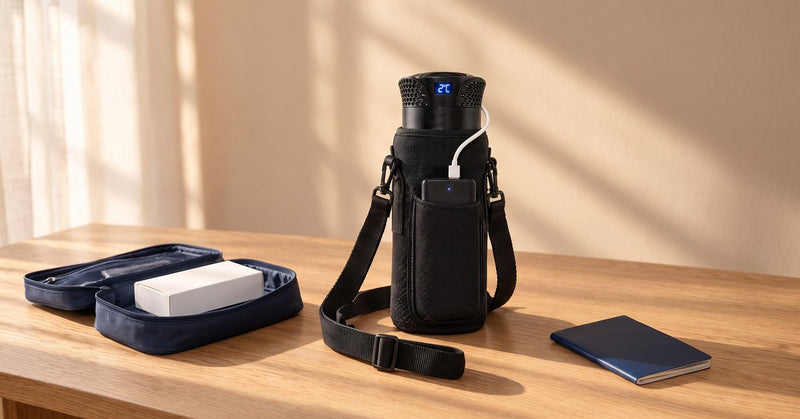
The Secrets Box by Practi plugs into a wall outlet or a power bank, stays within 2 to 8°C (36 to 46°F) as long as it is plugged in, and shows the temperature on a digital display. The power bank is sold separately, and it needs 10W of power (20,000mAh or more recommended, 10,000mAh also works). The box includes a USB to USB-C cable, and the fridge works from any USB source, including an adapter for the car's lighter socket, which also isn't included in the box. The overall height is 26 cm (10.2 in). Up to 7 Lantus-size pens and up to 5 Ozempic-size pens fit, and with wider pens the number depends on the pen type. The full list is on the product page. One more thing to be upfront about: there's no disconnect alert, so check the connection now and then.
See the product page · Read next: Medication cooler bag or portable fridge? The difference nobody explains
How this article was written. We gathered this information from public sources online and brought it together in one place. We are not a medical body, we have no medical or pharmacy qualification, and no medical professional has gone over this article.
Accurate as of the update date shown at the top of this article. Information may change. Security procedures, airline guidelines, medication leaflets and product specifications change from time to time, and the information here may no longer be up to date. It is the reader's responsibility to verify every detail with the official source before acting on it.
This article is general information, not medical advice. For questions about your medication, talk to your pharmacist or doctor. It contains no recommendation on medication storage, dose, method of use or how long a medication stays usable. The only sources for those questions are your medication's patient leaflet, your pharmacist and your doctor. Responsibility for storing and using the medication lies solely with the user and their healthcare provider. The Secrets Box is a cooled carrying case for medication and is not a medical device.
Questions? You can contact us.
Another question? All frequently asked questions · or message us on WhatsApp