Medication Cooler Bag or Portable Fridge? The Difference Nobody Explains

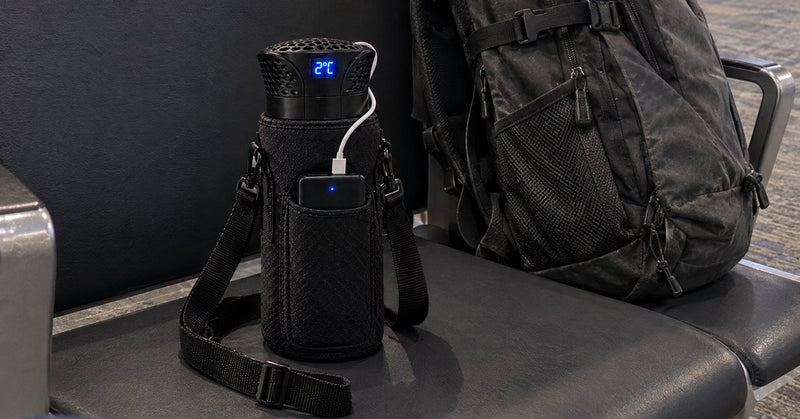
Looking for a medication cooler bag? Here's the difference in one line: a regular cooler bag insulates, and doesn't produce cold by itself. It relies on ice packs, which start to thaw the moment you take them out. An actively cooled portable fridge produces cold as long as it is plugged in to a wall outlet or a power bank (the power bank is sold separately), and shows the temperature on a display. The first is light and inexpensive. The second stays within 2 to 8°C (36 to 46°F) as long as it is plugged in, and shows you the number.
In this article
First, honestly: we're not a regular cooler bag
Most people searching for this type "medication cooler bag" or "insulin cooler travel case", not "portable medication fridge". That makes sense: a cooler bag is what everyone knows.
So let's say it plainly: our product isn't a regular cooler bag, it's an electric medication cooler: a portable medication fridge that produces cold by itself as long as it is plugged in, and doesn't rely on ice packs. If you got here from a search for a cooler bag, this article explains both options honestly, including where the cooler bag is the better choice.
What a passive cooler bag does better
This isn't a polite section. These are real advantages, and sometimes they're the deciding ones:
- Light, and usually the smaller expense of the two. A simple insulated bag usually costs less than an active cooling unit, but prices vary by model, size and supplier.
- Needs no power. No outlet, no power bank, and nothing to forget to charge.
- Nothing to break. It has no motor, display or electronics.
- Goes through security. The TSA states that medically necessary ice packs and gel packs are allowed in a reasonable quantity, even if they're thawed or partly liquid, and that you must declare them to the officer at the checkpoint.
Source: TSA, Gel Ice Packs. Note the caveat the TSA itself adds to every item: the final decision on whether an item gets through rests with the officer at the checkpoint. There's no such thing as "sure to get through", even when the rule is published.
The practical meaning: for a day at the beach, a drive of a few hours, a hospital appointment, or as a backup for when there's no power, a good cooler bag with ice packs is the right choice. Not out of generosity, but because that's the answer.
The two drawbacks of a cooler bag with ice packs
The problem with a cooler bag isn't that it doesn't work. It works. It has two drawbacks on a long trip.
The first: its cooling is limited in time. A cooler bag doesn't produce cold, so it cools only until the ice pack melts. A fridge with active cooling, like The Secrets Box, produces cold by itself and keeps cooling as long as it is plugged in to a wall outlet or a power bank (the power bank is sold separately).
The second: you don't know when it stopped.
An ice pack starts to thaw the moment it leaves the freezer, and how fast it thaws depends on the temperature around it, how often you opened the bag, and how much of the space is full. In the seventh hour of a connection, you have no data. You have a feeling.
And there's another side here that almost nobody talks about: the question isn't only whether it's too warm, but also whether it's too cold. The range commonly used for medication that needs refrigeration is 2 to 8°C (36 to 46°F), and it's a range in both directions. With a frozen ice pack in the bag, there's no way to see whether the temperature has dropped below the range.
And what we won't do: we won't write what happens to medication that went below the range, we won't write whether it's still usable, and we won't write how long it may be outside the fridge. The storage and use instructions for your medication are written in its patient leaflet, and the people who answer these questions are your pharmacist or your doctor.
What active cooling does differently
The difference isn't "colder". The difference is active cooling: the fridge produces cold by itself and stays within 2 to 8°C (36 to 46°F) as long as it is plugged in. In practice, that's two things:
- Cold that's produced, not cold that's preserved. As long as the unit is plugged in to a wall outlet or a power bank (the power bank is sold separately), it stays within 2 to 8°C (36 to 46°F). The cold doesn't depend on an ice pack that is thawing.
- A display. As long as the unit is plugged in, you see the temperature, and you don't have to guess.
The Secrets Box also has a smart system that prevents freezing, runs at under 40dB, and meets TSA rules for medication on flights. It's 26 cm (10.2 in) tall and 8.5 cm (3.3 in) wide, like a water bottle. You can find your pen in the list of pens and syringes that fit The Secrets Box.
Power source: what you really need, and what isn't included
This point is the difference between "it works" and "it works for you", so it's spelled out here and not in a footnote:
- The unit works from any USB source. A wall outlet, a power bank, or a USB adapter for the car's lighter socket.
- The power bank is sold separately, and the car adapter isn't included in the box either. The box includes a USB to USB-C cable and a wall charger.
- It needs 10W of power. 20,000mAh or more is recommended, and 10,000mAh also works. A power bank that's too weak is a common reason the cooling doesn't hold up the way you expected.
And when there's no power at all: the bio-gel ice pack
The unit also has a secondary bio-gel cooling method that works without power. The following figures are supplier data, not our own measurement:
- At an ambient temperature of 30°C (86°F): 33 hours, according to supplier data.
- At an ambient temperature of 35°C (95°F): 30 hours, according to supplier data.
- At an ambient temperature of 40°C (104°F): 28 hours, according to supplier data.
The last figure is the one that matters for an Israeli summer and a day outdoors. Notice what these figures do and don't say: they refer to how long the unit itself stays within the range, and they're a product figure, not an instruction about any medication.
Three limitations, before you decide
- The power bank and the car adapter are sold separately. That's an extra expense, and it's worth factoring in when you compare prices.
- It has no alert for being unplugged. This is a real objection that came up in a customer review, and it's valid. Check the connection now and then.
- With the bio-gel ice pack, cooling is limited in time. Without a power source you're back in a world where time is limited. The display works only when the fridge is plugged in, so in ice pack mode there is no temperature reading.
Cooler bag with ice packs vs electric medication cooler: comparison table
| Cooler bag with ice packs | Portable medication fridge | |
|---|---|---|
| Where the cold comes from | Ice packs frozen in advance | Produced in the unit itself, as long as it is plugged in |
| Power | Not needed | A wall outlet or a 10W power bank. The power bank is sold separately |
| How long it cools | Until the ice pack thaws. Depends on the heat outside and on how often you open the bag | As long as it is plugged in to an outlet or to a charged power bank |
| You can see the temperature | Usually not | Yes, on a digital display, as long as it is plugged in |
| Weight and price | Light, and usually costs less | Heavier and costs more |
| Best suited to | A few hours, a day at the beach, a backup for when there's no power | A flight with a connection, a vacation of a week or more, an Israeli summer |
How to choose
A cooler bag with ice packs: an outing of a few hours, a day at the beach, a short trip, a limited budget, or a backup for when there's no power.
Active cooling: a flight with a connection, a vacation of a week or more, a hotel whose minibar isn't a real fridge, an Israeli summer, and above all: when you want continuous cooling for the whole trip, as long as the fridge is plugged in, and want to see the temperature instead of guessing it.
And you don't have to choose: the cooled unit for the trip, and ice packs in your bag as a backup for a day with no outlet.
Questions that keep coming up
What is the difference between a medication cooler bag and a portable medication fridge?
A cooler bag insulates and relies on ice packs, which start to thaw the moment they leave the freezer. A portable medication fridge produces cold by itself as long as it is plugged in to a wall outlet or a power bank (the power bank is sold separately), and shows the temperature on a display.
What is an electric medication cooler?
A medication cooler that produces cold by itself instead of relying on ice packs. It stays within 2 to 8°C (36 to 46°F) as long as it is plugged in to a wall outlet or a power bank (sold separately), and shows the temperature on a display. It's another name for a portable medication fridge.
When is a cooler bag with ice packs enough?
For a day at the beach, a drive of a few hours, a hospital appointment, or as a backup for when there's no power.
What is the drawback of a cooler bag with ice packs on a long trip?
Its cooling is limited in time: it cools only until the ice pack melts, while a fridge with active cooling keeps cooling as long as it is plugged in. There is also no way to know when it stopped, or to see whether the temperature has dropped below the range.
Can you go through security with ice packs and gel packs?
The TSA states that medically necessary ice packs and gel packs are allowed in a reasonable quantity, even when thawed, and that you must declare them to the officer. The final decision on whether an item gets through rests with the officer at the checkpoint.
What do you need for a portable medication fridge to work away from home?
A 10W USB source: a wall outlet, a power bank or a USB adapter for the car's lighter socket. The power bank is sold separately, and the car adapter is sold separately too. The fridge stays within 2 to 8°C (36 to 46°F) as long as it is plugged in.
The bottom line
A cooler bag buys you time, until the ice pack melts. Active cooling stays within 2 to 8°C (36 to 46°F) as long as it is plugged in, and the display shows the temperature. They're not the same thing, and on a long trip you feel the difference.
The Secrets Box, an electric medication cooler, plugs in to a wall outlet or a power bank, stays within 2 to 8°C (36 to 46°F) as long as it is plugged in, and shows the temperature on a digital display. The power bank is sold separately.
Read next: Medication in your suitcase or your hand luggage? The short answer and why · Flying from Israel with refrigerated medication: what really happens at Ben Gurion security
How this article was written. We gathered this information from public sources online and brought it together in one place. We are not a medical body, we have no medical or pharmacy qualification, and no medical professional has gone over this article.
Accurate as of the update date shown at the top of this article. Information may change. Security procedures, airline guidelines, medication leaflets and product specifications change from time to time, and the information here may no longer be up to date. It is the reader's responsibility to verify every detail with the official source before acting on it.
This article is general information, not medical advice. For questions about your medication, talk to your pharmacist or doctor. It contains no recommendation on medication storage, dose, method of use or how long a medication stays usable. The only sources for those questions are your medication's patient leaflet, your pharmacist and your doctor. Responsibility for storing and using the medication lies solely with the user and their healthcare provider. The Secrets Box is a cooled carrying case for medication and is not a medical device.
Questions? You can contact us.
Another question? All frequently asked questions · or message us on WhatsApp