Medication Cooler for 24 Hours or More: What Are the Options

A medication cooler for 24 hours or more: what are the options? Three. A cooler bag with ice packs makes no cold, so it's time-limited. An electric medication cooler (portable medication fridge) makes its own cold and stays within 2 to 8°C (36 to 46°F) as long as it is plugged in to an outlet or power bank. The power bank is sold separately. Without power, a bio-gel ice pack is backup.
In this article
Why is a cooler bag with ice packs limited in time?
Because it insulates, and doesn't cool. The cold comes from the ice packs you froze at home, and from the moment they leave the freezer they only thaw.
How long does that take? We won't write a number of hours here, because there is no single official number. It depends on the bag itself, the size of the ice packs, the heat outside and how many times you open it. For a short outing it's a light and simple solution. On a day that runs from your front door to the hotel room, with a long flight or a connection, the question is no longer only how long, but how you know. In a cooler bag without a thermometer there's no number to look at, only a feeling.
We wrote the full comparison, including the situations where a regular cooler bag is the right choice, in Medication cooler bag or portable fridge. Here we focus on one question: what limits each solution in time.
What changes with an electric medication cooler?
The source of the cold. An electric medication cooler, or portable medication fridge, produces cold by itself instead of preserving cold that was prepared in advance. There's no ice pack thawing inside it, so the time depends on power and not on ice.
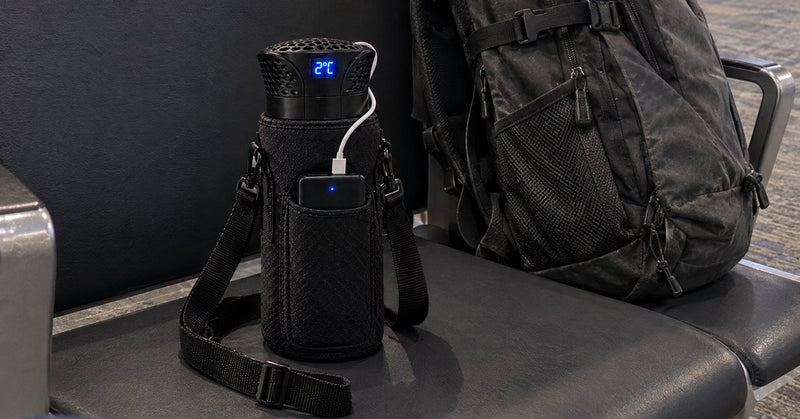
The Secrets Box by Practi stays within 2 to 8°C (36 to 46°F) as long as it is plugged in to a wall outlet or a power bank. The power bank is sold separately. The second advantage is the display: it shows the temperature, so you see a number instead of guessing. A smart system prevents freezing, and the temperature doesn't drop below 2°C (36°F).
It works from any USB source: a wall outlet, a power bank, or a USB adapter for the car's cigarette lighter socket. The box includes a USB to USB-C cable and a wall charger. You plug in to a wall outlet, or to a power bank with 10W output (20,000mAh or more is recommended, and 10,000mAh also works). The power bank and the car adapter are sold separately.
And one limitation worth knowing in advance: there is no alert when it's disconnected from power. So it's worth making sure now and then that the cable is connected.
And what happens when there's no power along the way?
For that, the box includes a bio-gel ice pack, a backup for when there's no power. According to supplier data, on the ice pack alone the fridge stays within the cooling range for 33 hours at an ambient temperature of 30°C (86°F), 30 hours at 35°C (95°F) and 28 hours at 40°C (104°F).
Two things about these numbers. They are supplier data, and they always come with the temperature outside. And they describe the fridge, not any medication: what applies to your medication is written in its patient leaflet, and your pharmacist is the person to ask.
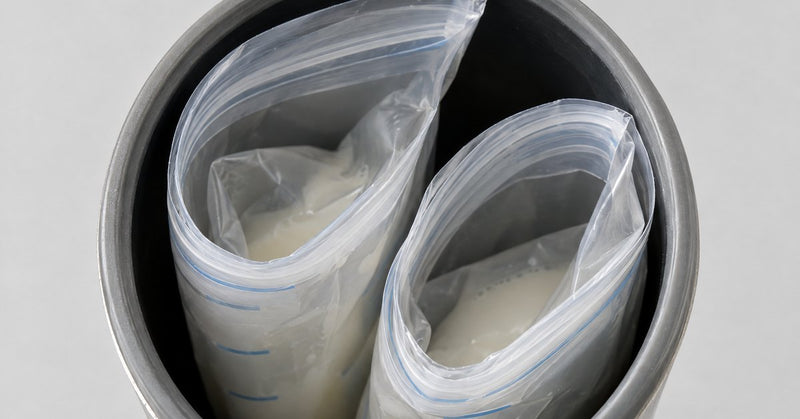
The rule here is simple: either power or the ice pack, never both together. When the fridge is plugged in, you don't put an ice pack in it. Freeze the ice pack at least 12 hours ahead, and before use wet it with water and wait about 2 minutes. The medication doesn't touch the ice pack directly. Put it in the protective case, or wrap it in another insulating material.
One thing worth factoring into your plan: the ice pack starts to thaw from the moment it leaves the freezer, even when it is not in use. Later in the journey, the backup is a charged power bank, or a freezer at your destination.
The display works only when the fridge is plugged in, so in ice pack mode there is no temperature reading.
What is the difference between the three solutions?
The difference is in what decides when the cooling ends. The table sorts it by type of solution.
| Cooler bag with ice packs | Portable medication fridge on a bio-gel ice pack, no power | Portable medication fridge plugged in | |
|---|---|---|---|
| Where the cold comes from | Ice packs frozen in advance | A bio-gel ice pack frozen in advance | The fridge produces cold by itself |
| What limits the time | The ice packs thawing. There is no single official number | According to supplier data: 33 hours at an ambient 30°C (86°F), 30 hours at 35°C (95°F), 28 hours at 40°C (104°F) | The power source. Stays within 2 to 8°C (36 to 46°F) as long as it is plugged in (the power bank is sold separately) |
| What you need on the way | Nothing | Nothing | A wall outlet or a power bank (sold separately) |
| What you prepare in advance | Freeze the ice packs | Freeze the ice pack at least 12 hours ahead | Charge the power bank |
| When it fits | A short outing | A gap without power, as long as the ice pack is frozen | A long flight, a connection, a full day out |
How do you plan a day of 24 hours or more?
Start from the clock, not from the gear. Five steps:
- Count door to door. Not only the flight hours: also the way to the airport, the wait, the connection and the way to the hotel.
- Mark where there is power. At home, in the car (with a USB adapter for the cigarette lighter socket, which is sold separately), at the airport and at the hotel. A charging outlet at the seat doesn't exist on every airline and every aircraft, so don't build on it.
- Decide what covers the gaps. A charged power bank, and when there is no power at all, the bio-gel ice pack.
- Prepare the night before. Charge the power bank and freeze the ice pack. On the day of travel, plug in first, wait until the display shows 2 to 8°C (36 to 46°F) (the XL 2.0 within 15 to 20 minutes, the base model within 20 to 30 minutes), and only then put the medication in.
- Take everything into the cabin. The fridge travels with you in the cabin and not in your suitcase, and it meets TSA rules for medication on flights. The rules for power banks are set by the airline, so it's worth checking its policy before the flight. Clalit, the Israeli health fund, also writes (in Hebrew) that it is preferable to keep medication in your hand luggage and not in the suitcase sent to the aircraft hold, and the same page carries the instruction that medication be kept in its original packaging. More on this in our guide to medication in your hand luggage or your suitcase.
Source: Clalit Health Services, medication to take abroad (Hebrew)
As for space: the fridge is 26 cm (10.2 in) tall and 8.5 cm (3.3 in) wide, and you carry it like a water bottle. It fits the bottle pocket on the side of your bag, and the air vents stay uncovered. You can find your pen in the pen list.
A portable medication fridge sounds expensive next to a regular cooler bag. On the other side stands a long travel day where you see a number on the display, with fewer worries on the way. All the details are on The Secrets Box product page.
Questions that keep coming up
Is there an electric medication cooler that lasts 24 hours?
Yes, provided it stays plugged in the whole time. An electric medication cooler makes its own cold, so it doesn't depend on an ice pack that thaws. The Secrets Box stays within 2 to 8°C (36 to 46°F) as long as it is plugged in to a wall outlet or a power bank. The power bank is sold separately. On a power bank, the time depends on its capacity, and we don't publish a number of hours.
Is it a rechargeable medication cooler? Does it have a built-in battery?
No. There is no built-in battery. The fridge works from any USB source: a wall outlet, a power bank, or a USB adapter for the car's cigarette lighter socket. The power bank and the car adapter are sold separately.
Is a medication cooler bag with ice packs enough for 24 hours?
It depends. A cooler bag with ice packs doesn't produce cold, and its time depends on the bag, the ice packs and the heat outside. There is no single official number for that, so we don't write one. What applies to your medication is written in its patient leaflet.
Can you put an ice pack in the fridge while it is plugged in?
No. Either power or the ice pack, never both together. When the fridge is plugged in, you don't put an ice pack in it. The ice pack is a backup for when there's no power.
How this article was written. We gathered this information from public sources online and brought it together in one place. We are not a medical body, we have no medical or pharmacy qualification, and no medical professional has gone over this article.
Accurate as of the update date shown at the top of this article. Information may change. Security procedures, airline guidelines, medication leaflets and product specifications change from time to time, and the information here may no longer be up to date. It is the reader's responsibility to verify every detail with the official source before acting on it.
This article is general information, not medical advice. For questions about your medication, talk to your pharmacist or doctor. It contains no recommendation on medication storage, dose, method of use or how long a medication stays usable. The only sources for those questions are your medication's patient leaflet, your pharmacist and your doctor. Responsibility for storing and using the medication lies solely with the user and their healthcare provider. The Secrets Box is a cooled carrying case for medication and is not a medical device.
Another question? All frequently asked questions · or message us on WhatsApp