How to Keep Ozempic Cool on a Long Trip

Ozempic is an injection pen that needs refrigeration. How long it may be kept outside the fridge, and under what conditions, is written in the patient leaflet for your product, and we don't give a number here. What is practical for a long trip: knowing where to find the right leaflet, and keeping the pen in the range the manufacturer specifies all the way, while you can see the temperature.
In this article
This information is general and for convenience only, and it is not medical advice. Medication storage, temperatures and doses are set by your doctor, your pharmacist and the manufacturer's leaflet. Talk to a professional before making any decision.
Why you won't find a number here
If you've searched online for how long Ozempic can stay out of the fridge, you've probably already been given a number. We sell a portable fridge, so a number appearing here would read as our instruction. It isn't ours, and we're not the right address for it.
There's also a practical reason. Every dose and every product has its own leaflet, and the leaflet text gets updated. When we checked the Ozempic listing in the Israeli Ministry of Health drug database, it showed several dated versions of the leaflet, the latest of them updated in May 2026. Any number that was once copied into a commercial blog stays frozen there, even when the leaflet moves on.
So we don't say how long. We show you where it's written.
How to find the leaflet for your product
The official source in Israel is the Ministry of Health drug database (Pharmaceutical Division). It's open to anyone, with no registration. The labels below are translated from the site's Hebrew interface. Here's how to get to the leaflet:
- Go to the website. The tab that opens by default is search for a medication by brand name or active ingredient.
- In the search bar, type the name that appears on your box. You can use Hebrew or English. If the name isn't recognized, try the name of the active ingredient, which also appears on the box.
- Choose from the autocomplete list that opens, and click search.
- On the result card, check that the product name and the dose match what you have in hand. Each strength has its own registration number, and so its own leaflet. Click more details.
- On the product page, open the leaflets tab. It shows a patient leaflet, a physician leaflet and safety update notices for the leaflet. Choose the patient leaflet in Hebrew with the most recent date.
- Inside the leaflet, scroll to the section called how to store the medication? and within it to the heading storage conditions. That's where the storage and use instructions for your product are written, before opening and during use.
It's worth photographing this section on your phone before the trip. It takes half a minute, and it saves you searching online from a hotel room.
Two limitations we want to be upfront about: the database itself carries a note that some of its data may be incomplete or inaccurate, and that it isn't an official document. And in any case, the leaflet in your box, and the pharmacist who gave it to you, take priority over any website, including this one.
Why a long trip is a different problem from a short one
On a three-hour flight there isn't much to plan. On a two-week trip, four points add up that are easy to miss:
- The environment the pen is actually in, not the forecast. The storage conditions in the leaflet refer to the environment the pen really sits in. A parked car, a bag on the beach and a balcony at noon are not the same as an air-conditioned room, even in the same city on the same day.
- A hotel fridge is a gamble. Some rooms have no fridge at all, some have a minibar that switches off when you leave the room, and some small fridges actually freeze things. Too cold is outside the range just as much as too hot.
- Delays. A flight delayed by seven hours, a missed connection, a suitcase that arrives a day later. Each of them lengthens the time the medication spends outside a controlled environment.
- The way back, too. People carefully plan the outbound flight, and arrive at the return flight without the same preparation.
What you won't find here, on purpose: what to do if the medication went outside the range. That's a question for your pharmacist and the leaflet, not for a commercial website.
Three things to sort out before Ben Gurion Airport
Clalit Health Services publishes guidance for patients traveling abroad, and three points in it matter to anyone carrying an injection pen:
- "Travelers carrying medication given by syringe or pump, such as insulin, must show a prescription for the medication to representatives of the security authorities at the airport."
- "Airport security guidelines require medication to be kept in its original packaging."
- "It's preferable to keep medication in your hand luggage and not in the suitcase sent to the hold."
Source: Clalit Health Services, medication to take abroad (Hebrew)
The second point is the one most travelers miss, because it's easier to take the pen out of the box and pack only the pen. The box carries the name, the dose and the expiry date, it physically protects the pen in a crowded bag, and the leaflet inside it is exactly the document we talked about above.
A limitation we want to be upfront about: the Israel Airports Authority doesn't publish a dedicated, detailed page on refrigerated medication, the way some other authorities do. If something is critical for your trip, a call to your airline before the flight is the only way to know for sure.
Where a portable fridge fits in
The problem on a long trip isn't just keeping things cool. The problem is not knowing. With a cooler bag and ice packs, you can't tell the temperature inside or when the ice pack has melted.
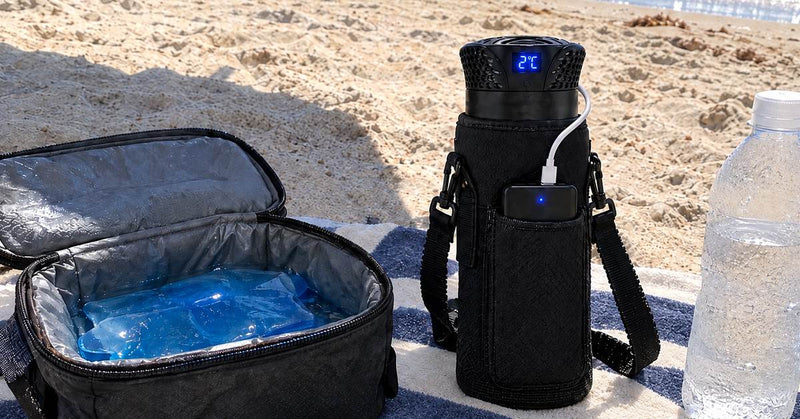
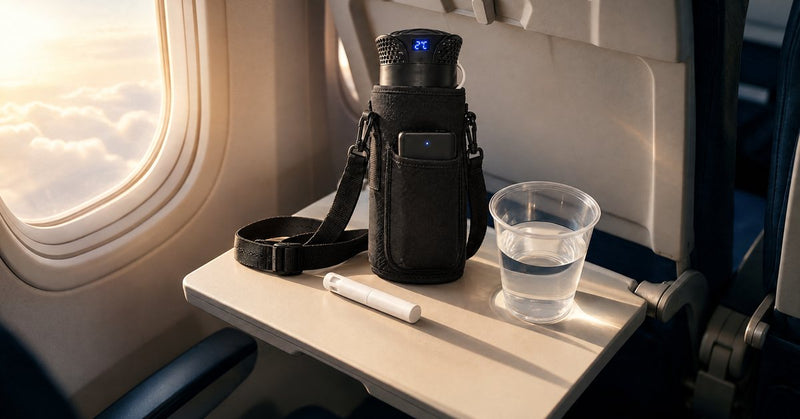
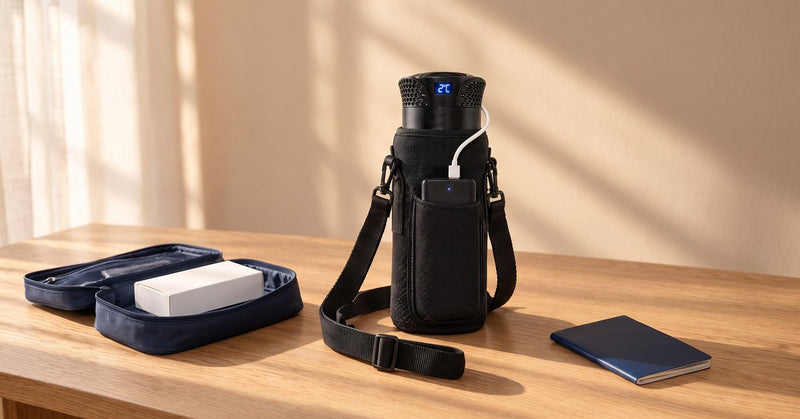
The Secrets Box by Practi is a cooled carrying case for medication. It connects with a USB to USB-C cable, keeps 2 to 8°C (36 to 46°F) for as long as it's plugged in, and shows the temperature on a digital display. It's 26 cm (10.2 in) tall and it meets TSA guidelines for medications on flights. Without power, it works with a bio-gel ice pack, and according to supplier data that gives about 30 hours at 35°C (95°F).
It works from any USB source: a wall outlet, a power bank, or a USB adapter for the car's 12V socket. Note that the last two are separate items. The power bank is sold separately, and it needs a 10W output (20,000mAh or more recommended, 10,000mAh also works), and the car adapter isn't included in the box either.
One more thing that's important to say openly: there's no disconnect alert, so check now and then that it's connected properly, and look at the display.
In terms of space, up to 5 Ozempic-size pens fit. The number depends on the size of the pen, not on the medication family, and the full list by product name is on the product page.
Frequently asked questions
Can I take an injection pen through security?
Yes. The Israeli guidance is to show a prescription and keep the original packaging. Clalit adds that you should tell the officer before your bag is scanned, not after.
So how long can the pen be kept outside the fridge?
We don't give a number, and it's not a good idea to take one from a commercial website, including ours. It's written in the patient leaflet for your product and dose, under the section on how to store the medication. The six steps to get there are above.
And what if the pen has already gone outside the conditions the leaflet describes?
That's a question for the pharmacist who gave you the medication and for your doctor. We can't answer it, and we don't try.
Just before you head out
Most of the preparation for traveling with an injection pen is paperwork: a prescription, the original packaging, the leaflet. What's left open is the temperature along the way, and there the real difficulty is the uncertainty, not the heat itself. If that's your difficulty, you can read about The Secrets Box, and also read the article on flying from Israel with refrigerated medication.
How this article was written. We gathered this information from public sources online and brought it together in one place. We are not a medical body, we have no medical or pharmacy qualification, and no medical professional has gone over this article.
Accurate as of September 27, 2026. Information may change. Security procedures, airline guidelines, medication leaflets and product specifications change from time to time, and the information here may no longer be up to date. It is the reader's responsibility to verify every detail with the official source before acting on it.
This article is general information, not medical advice. For questions about your medication, talk to your pharmacist or doctor. It contains no recommendation on medication storage, dose, method of use or how long a medication stays usable. The only sources for those questions are your medication's patient leaflet, your pharmacist and your doctor. Responsibility for storing and using the medication lies solely with the user and their healthcare provider. The Secrets Box is a cooled carrying case for medication.
Another question? All frequently asked questions · or message us on WhatsApp